Welcome to Maintenance-IT
At a time when data-driven decisions determine efficiency and competitiveness, machine learning and data science are opening up new opportunities for optimization, prediction, and automation, as well as a new form of preventive maintenance.
AI support for maintenance can be divided into three structural levels.
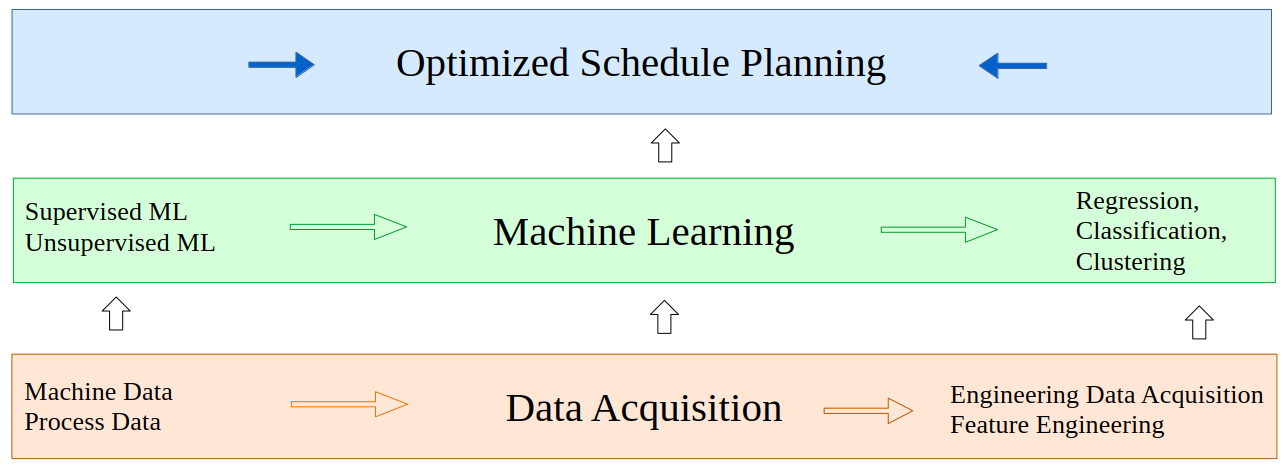
1. Lower level – Data acquisition with engineering data acquisition and feature engineering
This is where machine data is collected, processed, and transformed into meaningful characteristics. It is the technical foundation on which everything else is built.
2. Middle level – supervised/unsupervised machine learning with application of
- Regression → Estimate remaining useful life (RUL)
- Classification → Identify fault classes
- Clustering → Find patterns, operating states, anomalies
3. Upper level – schedule planning with the help of a solver
The goal is to use ML results to calculate optimal schedules, minimize maintenance costs, increase plant reliability, plan resources more efficiently, and minimize downtime. Deterministic solvers deliver fixed, predictable solutions, while stochastic solvers take probabilities into account.
Going one step further, more detailed requirements can be identified. Structurally, three levels can be recognized again. The lower level shows the use of edge computers for efficient data collection. In the second level, data processing is carried out using supervised/unsupervised machine learning algorithms. The result of this work forms the basis for the stochastic/deterministic solver algorithms for determining an optimized maintenance plan.
The combination of decades of practical experience in maintenance/servicing, automation/IT, computing technology, mechanics/pneumatics, and troubleshooting and diagnostics combines to form a decisive advantage for meeting the actual requirements of industrial plants.